AI Won't Replace You (But Someone Else Might)
[caption id=“attachment_976” align=“aligncenter” width=“2912”] Credits: Author via Midjourney.[/caption]
Technology has a habit of shaking up the workforce, but it’s less like a wrecking ball and more like a relentless interior designer. Sure, it rearranges the furniture (sometimes tossing out the rotary phone or the filing cabinet) but it rarely burns the whole house down.
The rapid advancement of artificial intelligence (AI) has led to widespread speculation. Many wonder about its potential to replace human workers across various industries.
From milkmen to bank tellers, history shows that jobs don’t vanish; they adapt. Artificial intelligence (AI), the latest buzzword keeping CEOs awake at night, isn’t here to replace you. But it is here to test how well you can keep up.
Let’s unpack the past to prepare for the future.
The Milkman’s Dilemma
In the 1950s, the milkman was as essential as morning coffee. He’d clink bottles on doorsteps before dawn, a hero of dairy logistics. Then affordable consumer refrigerators showed up in homes, and supermarkets began stocking milk by the gallon. Suddenly, the need for daily milk delivery faded.
[caption id=“attachment_972” align=“aligncenter” width=“858”]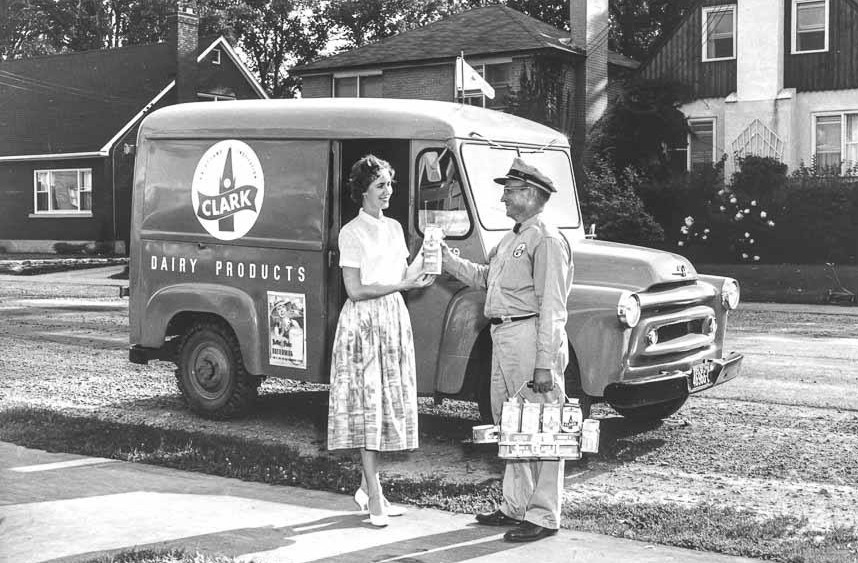 Clark’s Dairy, circa 1959. Credits: Wiki Commons.[/caption]
But here’s the twist: the milkman didn’t disappear. He pivoted.
By the 1960s, pizza deliveries became popular, and today, we live in an entire gig economy where drivers deliver everything from groceries to diapers, electronics, and pet supplies through services like Instacart, Shipt, and Uber.
The lesson? Jobs don’t die, they just put on a new uniform.
Bank Tellers vs. ATMs: A Love Story
When automated teller machines _(_ATMs) debuted in the 1970s, panic ensued. “Machines handling cash? What’s next—robots judging our credit scores? (Ouch, yes, that actually did happen.)
But, plot twist: ATMs didn’t replace tellers. Instead, they became their trusty sidekicks. By automating routine withdrawals, ATMs freed tellers to tackle more meaningful tasks, like helping customers untangle overdrafts, apply for loans, or navigate the existential dread of adulting.
The result? Between 1970 and 2010 (a time when ATMs were expected to replace bank tellers) the number of tellers in the U.S. actually doubled. Turns out, people still value human assistance, even in a world filled with self-checkout lanes.
When Jobs Do Vanish: A Moment of Silence for ‘Human Computers’
It is true that some jobs don’t evolve and really do disappear. One example is human computers. These were people who performed complex calculations by hand. Throughout the early to mid-20th century, human computers worked in fields like astronomy, engineering, and wartime code-breaking. NASA employed hundreds of them to calculate aircraft performance and rocket trajectories.
[caption id=“attachment_970” align=“aligncenter” width=“1041”]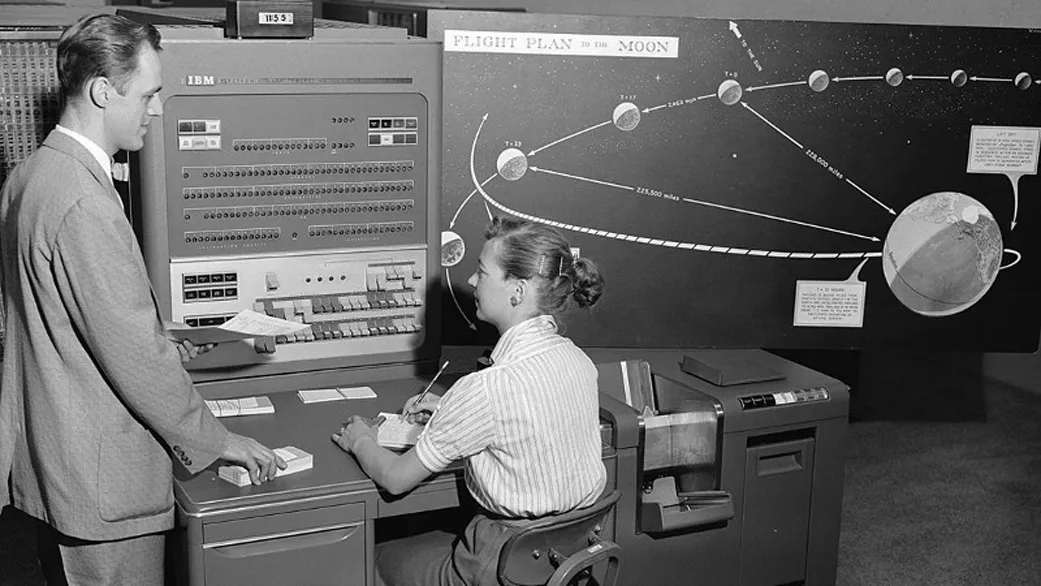 A “human computer” works with an early machine computer, the IBM 704. Credits: NASA/JPL-Caltech.[/caption]
But when electronic computers emerged in the 1960s, human computers were rendered obsolete. By the 1970s, the profession was gone.
Why? Because some tasks, like raw calculation, are simply better suited to machines.
AI Isn’t Coming for Your Job—But Someone Else Might Be
AI is different from previous technological disruptions. It won’t eliminate all jobs outright, but it will create a competitive advantage for those who know how to use it. If you don’t learn to integrate AI into your work, someone else will.
Consider two financial analysts:
- One manually sifts through reports, compiles data, and identifies trends by hand.
- The other uses AI tools to instantly process large datasets, generate insights, and optimize investment strategies.
The second analyst works faster, provides deeper insights, and delivers more accurate forecasts. If a company has to choose between them, the AI-savvy analyst has the edge.
AI won’t eliminate all jobs outright, but it will create a competitive advantage for those who know how to use it.
AI can process vast amounts of data at speeds far beyond human capabilities, uncovering patterns and insights that might elude human analysts. This pattern repeats across industries:
- Legal – A paralegal who uses AI to summarize case law will outperform one who doesn’t.
- Healthcare – A radiologist leveraging AI to detect anomalies in scans will diagnose patients more efficiently.
- Customer Service – An agent using AI to streamline inquiries and personalize responses will handle a higher volume of clients effectively.
- Logistics – A supply chain manager who uses AI for predictive analytics will optimize inventory better than one who relies solely on traditional methods.
Adaptable workers willing to learn new skills are more likely to thrive in an AI-enhanced workplace. AI isn’t going to replace worker. It’s workers using AI replacing those who don’t or won’t.
How to Future-Proof Your Career (Without Panic-Googling “Coding Bootcamps”)
[caption id=“attachment_975” align=“aligncenter” width=“2560”] Photo by JESHOOTS.COM on Unsplash[/caption]
The good news? You don’t need to be a programmer or AI expert to stay ahead. Here’s how:
- Learn How AI is Impacting Your Industry: Research AI tools in your field. For example, AI is transforming real estate by predicting home values and enhancing customer engagement through chatbots.
- Master AI-Augmented Workflows: Think of AI as an assistant, your new ‘work wife,’ not a replacement. Learn how to integrate it into your daily tasks.
- Marketing? Use AI for campaign analysis and A/B testing.
- Coding? GitHub Copilot can help you generate and refine code.
- Healthcare? AI-powered diagnostics enhance decision-making, not replace doctors.
- Finance? AI-driven forecasting tools improve investment strategies.
- Focus on Human Skills AI Can’t Replace: AI excels at automation but lacks creativity, emotional intelligence, and strategic thinking. Skills like leadership and problem-solving will always be valuable.
- Experiment and Learn: Most AI tools are accessible for free or at a low cost. Start using them now. The more comfortable you become, the more valuable you’ll be.
- Stay Adaptable: The workforce is changing fast. Those who thrived after the invention of the ATM or the internet weren’t the ones who resisted change but rather the ones who embraced it.
Bottom Line
The milkman became a delivery driver; the bank teller became a financial advisor. AI is just the latest chapter in this story. Embracing AI as a tool for enhancement allows individuals to position themselves for success in the evolving job market.
Will AI disrupt your job? Absolutely. Will it erase it? Only if you let it.