Are Students’ Attention Spans Broken, or Are Our Courses?
Everyone keeps saying students are broken. That their brains are fried by TikTok.
I don’t buy it.
Look at the numbers. MOOCs, those massive online courses everyone thought would save education, have completion rates under 10%. That’s a failure. Teachers in K-12 are seeing engagement drop off a cliff. But is it the kids? Or is it the fact that we’re still lecturing at them for an hour straight while they try to take passive notes in a world that moves at 1.5x speed?
We’re losing them because we’re boring them.
So now the buzzword is “microlearning.” Breaking things down. Little chunks. Five minutes here, a quiz there. It fits the brain better, apparently.
Duolingo does it. Khan Academy does it. Instead of a firehose of information, you get a drip feed. It builds momentum. And now, you add AI to the mix. Real-time adjustments. One kid gets a video because they failed the last concept; another gets a scenario because they’re bored.
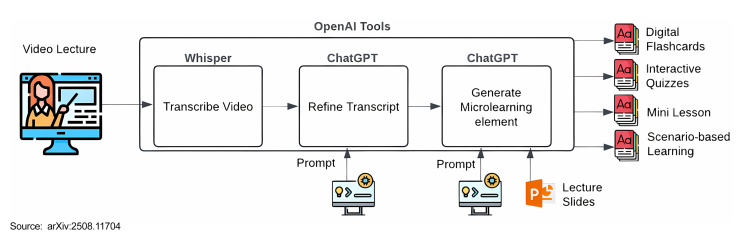
There was a study on this recently. An arXiv paper looked at computer science classes using AI-assisted microlearning. They found better retention. At UniDistance Suisse, they used a personal AI tutor for “spaced retrieval” (fancy term for asking you questions right before you forget the answer). Scores went up by 15 percentile points compared to the kids who didn’t use it.
But here’s where I get skeptical.
I teach game design. I teach theory. And I can tell you that a series of AI flashcards is not the same thing as learning. It just isn’t. You can memorize definitions all day, but that won’t help you understand context or synthesis. It won’t help you understand why a mechanic works. If we start thinking that answering a quiz correctly is the same thing as mastery, we are going to end up with a lot of people who know terms but don’t understand concepts.
It creates a surface-level understanding. You think you know it because you passed the quiz, but you don’t really know it.
I use short challenges, sure. I have students tweak a rule or playtest a mechanic. It’s quick. It wakes them up. But then we have to talk. Like, actually talk. One-on-one. About why that design choice mattered. About player psychology. That’s where the mentoring happens. That’s where the actual learning sticks.
Schools are rushing to buy these AI tutors. I get it. It scales.
But if we use them to replace human connection, we’re in trouble. AI can handle the drills. Let the machines do the rote work. But the actual teaching? The mentoring? The part where you connect two unrelated ideas? That’s us.
That’s the only part that really matters.