The Fascinating World of Zero-Player Games

Most video games are built around one central idea: player agency. You pick up a controller, sit at a keyboard, or tap a screen, and the world inside the game responds. But what if a game didn’t need a player at all? What if it simply ran on its own, unfolding according to rules rather than human input? Enter zero-player games, a fascinating category where gameplay is entirely automated.
What Are Zero-Player Games?
Zero-player games function without direct human control. Once set into motion, they operate independently, governed by algorithms, AI behaviors, or emergent systems. While this may sound counterintuitive—after all, what’s the point of a game if no one is playing?—zero-player games reveal a lot about simulation, evolution, and the nature of play itself.
Several well-known games and simulations fall into this category:
Conway’s Game of Life
Perhaps the most famous zero-player game, Conway’s Game of Life (which you can play here) isn’t a game in the traditional sense. Created by mathematician John Conway in 1970, it’s a cellular automaton that evolves based on a simple set of rules. You start with a grid of cells—some alive, some dead—and watch as patterns emerge, shift, and sometimes stabilize into complex, organic-looking formations. With no direct interaction beyond the initial state setup, it’s a pure example of emergent behavior.
Dwarf Fortress (Fortress Mode)
While Dwarf Fortress is typically a player-driven experience, it can be set up to run autonomously. The game’s world simulation, with its complex AI behaviors, procedural storytelling, and interwoven systems, can unfold entirely without human intervention. Some players even create fortresses, then step back and observe as dwarves live (and inevitably die) according to their programmed behaviors.
[caption id=“attachment_1011” align=“aligncenter” width=“1920”]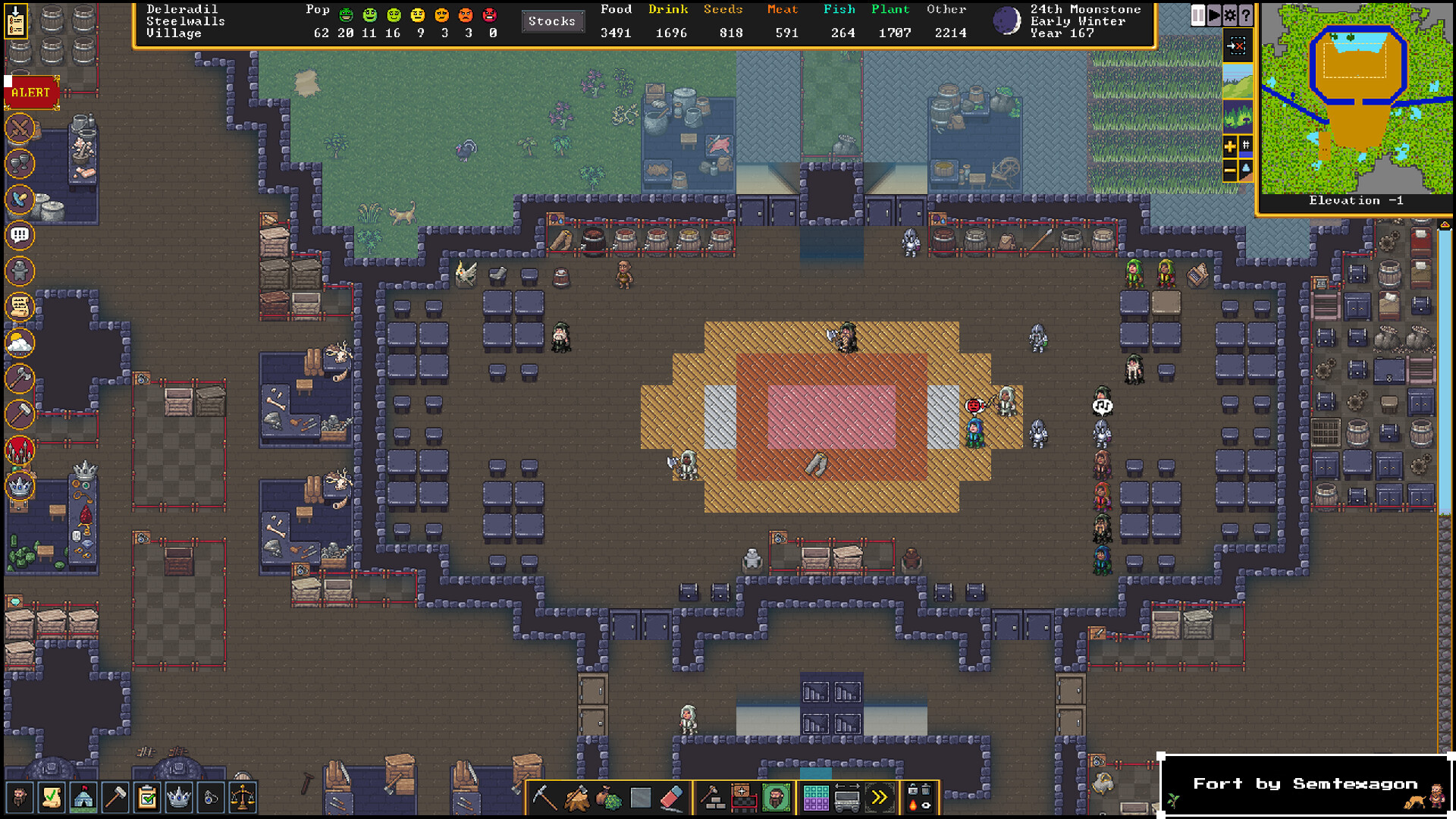 Dwarf Fortress[/caption]
AI-Generated Battles (RoboCode, AI Dungeon, and More)
There are games specifically designed for AI-on-AI competition. RoboCode allows players to program AI-controlled robots that battle each other, with no further player interaction after coding. Similarly, AI Dungeon generates text-based adventures where AI drives the narrative, responding dynamically to its own creations.
SimCity and Other City Builders
Many simulation games, like SimCity, Cities: Skylines, and The Sims, can function without direct player control. Once a city or a neighborhood is established, its inhabitants will continue living, working, and evolving based on the game’s rules. Some players set up self-sustaining societies and watch how they develop over time.
Evolution Simulations
Games and experiments like DarwinBots and Creatures simulate evolution, where digital organisms compete for survival. They mutate, adapt, and evolve entirely on their own, showcasing natural selection in real-time digital ecosystems.
What We Can Learn from Zero-Player Games
Zero-player games are more than just curiosity pieces; they serve several important purposes! They demonstrate how simple rules can create deeply complex and unpredictable systems. Watching Conway’s Game of Life or Dwarf Fortress unfold is like witnessing a miniature universe evolve, where patterns emerge, collide, and change in unexpected ways.
AI-driven games are also essential for advancing artificial intelligence and automation testing. By enabling AI to interact with itself, researchers can gain valuable insights into automated decision-making, behavioral modeling, and optimization. These systems allow developers to refine machine learning techniques and explore emergent behaviors without human input. In my work at Electronic Arts, particularly with EA Sports, I simulated entire seasons of the NFL and college basketball to assess the accuracy and viability of the results.
Beyond research, some zero-player games generate dynamic narratives, proving that storytelling doesn’t always require a guiding hand. Games like AI Dungeon and procedural world simulators create stories on the fly, crafting unique experiences without direct human authorship. This showcases how algorithms can shape compelling and unpredictable narratives.
Finally, there’s an undeniable entertainment factor in watching a system operate on its own. Whether it’s setting up a SimCity metropolis to see if it thrives or running AI-versus-AI battles, there’s a thrill in observing chaos and order emerge naturally. Sometimes, the most engaging games are the ones we simply sit back and watch unfold.
The Future of Zero-Player Games
As AI, procedural generation, and simulation technology progress, zero-player games could reach new levels of sophistication. Imagine an AI-driven RPG that evolves its story autonomously or a civilization simulator that develops entire cultures over millennia—much like Dwarf Fortress already does. As these systems become more advanced, the distinction between observer and player continues to blur, pushing the boundaries of what we define as “play.”
In a world obsessed with interactivity, zero-player games remind us that sometimes, the most compelling experiences come from stepping back and simply watching a world unfold on its own.
* Photo by Marius Niveri on Unsplash